5 Reasons Why SEC Data Is So Hard for RAG Engineers
Originally published on Medium
The investment analysis AI market is growing fast. FactSet has rolled out MCP-powered services, Bloomberg launched BloombergGPT, and Alphasense — backed by Goldman Sachs — offers RAG-based investment analysis. On the startup side, players like Reflexivity, Rogo, Bigdata, and Rize Capital are all building in this space.
All these services are using one critical data source: SEC filings. SEC data is centralized, publicly accessible, and covers every public company’s financial disclosures making it ideal for building investment AI. Yet many RAG engineers struggle to actually use it.
At Lucy, we don’t build investment RAG systems ourselves, but we deeply understand the challenges RAG engineers face, and we’re here to help solve them. Here are the six core obstacles when working with SEC data.
1. The Sheer Volume and Complexity
The scale of SEC data is very big. In 2024 alone, roughly 6,600 companies filed 10-Ks (annual reports), and about 67,000 8-Ks (current reports) were submitted. With approximately 490 different form types, manually understanding each one’s structure is practically impossible.
Individual filings are lengthy too. JPMorgan’s 2024 10-K, for example, runs 334 pages and exceeds 50,000 words. In addition, a mix of text, images, tables, and XBRL data, and preprocessing are very challenging for RAG engineers.
- JPMorgan(JPM) 2024 10-K https://www.sec.gov/Archives/edgar/data/19617/000001961725000270/jpm-20241231.htm
2. Wildly Inconsistent Document Structures
The SEC clearly defines what a 10-K must include: Parts I through IV, Items 1 through 16 from Business to Form 10-K Summary. There’s a standard table of contents that filers are supposed to follow.
SEC instructions:
Part I
- Item 1. Business
- Item 1A. Risk Factors
- Item 1B. Unresolved Staff Comments
- Item 1C. Cybersecurity
- Item 2. Properties
- Item 3. Legal Proceedings
- Item 4. Mine Safety Disclosures
Part II
- Item 5. Market for Registrant’s Common Equity, Related Stockholder Matters and Issuer Purchases of Equity Securities
- Item 6. [Reserved]:
- Item 7. Management’s Discussion and Analysis of Financial Condition and Results of Operations (MD&A)
- Item 7A. Quantitative and Qualitative Disclosures About Market Risk
- Item 8. Financial Statements and Supplementary Data
- Item 9. Changes in and Disagreements With Accountants on Accounting and Financial Disclosure
- Item 9A. Controls and Procedures
- Item 9B. Other Information
Part III
- Item 10. Directors, Executive Officers, and Corporate Governance
- Item 11. Executive Compensation
- Item 12. Security Ownership of Certain Beneficial Owners and Management and Related Stockholder Matters
- Item 13. Certain Relationships and Related Transactions, and Director Independence
- Item 14. Principal Accountant Fees and Services
Part IV
- Item 15. Exhibits and Financial Statement Schedules
- Item 16. Form 10-K Summary
But reality is messier. Take McDonald’s 10-K: instead of the standard SEC structure, it uses custom sections like “Forward-Looking Statements,” “About McDonald’s,” and “Management’s Discussion and Analysis.”
- McDonald(MCD) 2024 10K https://www.sec.gov/Archives/edgar/data/63908/000006390825000012/mcd-20241231.htm
- Forward-Looking Statements
- About McDonald’s
- Business Summary
- Management’s Discussion and Analysis of Financial Condition and Results of Operations
- Management’s View of the Business
- 2024 Financial Performance
- Strategic Direction
- Outlook
- Consolidated Operating Results
- Cash Flows
- Consolidated Operating Results
- Cash Flows
- Financial Position and Capital Resources
- Other Matters
- Other Key Information
- Stock Performance Graph
- Market for Registrant’s Common Equity, Related Stockholder Matters and Issuer Purchases of Equity Securities
- Risk Factors
- Cybersecurity
- Legal Proceedings
- Properties
- Information About our Executive Officers
- Availability of Company Information
- Financial Statements and Supplementary Data
- Controls and Procedures
- Security Ownership of Certain Beneficial Owners and Management and Related Stockholder Matters
- Exhibits and Financial Statement Schedules
- Form 10-K Cross-Reference Index
When every company organizes documents differently, chunking by Item becomes impossible, and hallucination rates in RAG systems go up.
3. Content Hidden Behind References
Many 10-K sections don’t contain actual content — they just point elsewhere. This is especially common in Items 10 through 14.
Verizon’s 10-K Item 12 (Security Ownership), for instance, simply says: “See our definitive Proxy Statement.”
- Verizon(VZ) 10-K Item 12 https://www.sec.gov/Archives/edgar/data/732712/000073271225000006/vz-20241231.htm#i1da8bfafa1cd48a5a9f25432356b4db8_301
- Item 12. Security Ownership of Certain Beneficial Owners and Management and Related Stockholder Matters For information with respect to the security ownership of certain beneficial owners, the directors and executive officers, see the section entitled “Stock ownership — Security ownership of certain beneficial owners and management” in our definitive Proxy Statement to be filed with the Securities and Exchange Commission and delivered to shareholders in connection with our 2025 Annual Meeting of Shareholders, which is incorporated herein by reference.
Johnson & Johnson’s Item 13 takes a different approach, directing readers to Item 1 within the same document.
- Johnson & Johnson(JNJ) 10-K item 13 https://www.sec.gov/Archives/edgar/data/200406/000020040625000038/jnj-20241229.htm
- Item 13. Certain relationships and related transactions, and director independence The information called for by this item is incorporated herein by reference to the material under the captions Item 1.
These reference structures make it nearly impossible for RAG systems to provide complete answers.
4. Critical Information Buried in Exhibits
Key information often lives in Exhibits rather than the main filing. McDonald’s mentions its Insider Trading Policy in the body text, but the actual policy? “See Exhibit 19.”
- McDonald(MCD) 2024 10K https://www.sec.gov/Archives/edgar/data/63908/000006390825000012/mcd-20241231.htm
- INSIDER TRADING POLICY
- The Company has adopted an insider trading policy governing the purchase and sale and other dispositions of Company securities by our directors, officers and employees. The Company believes this policy is reasonably designed to promote compliance with insider trading laws, rules and regulations, and NYSE listing standards. A copy of the Inside Information and Securities Trading Policy is filed as Exhibit 19 to this Form 10-K.
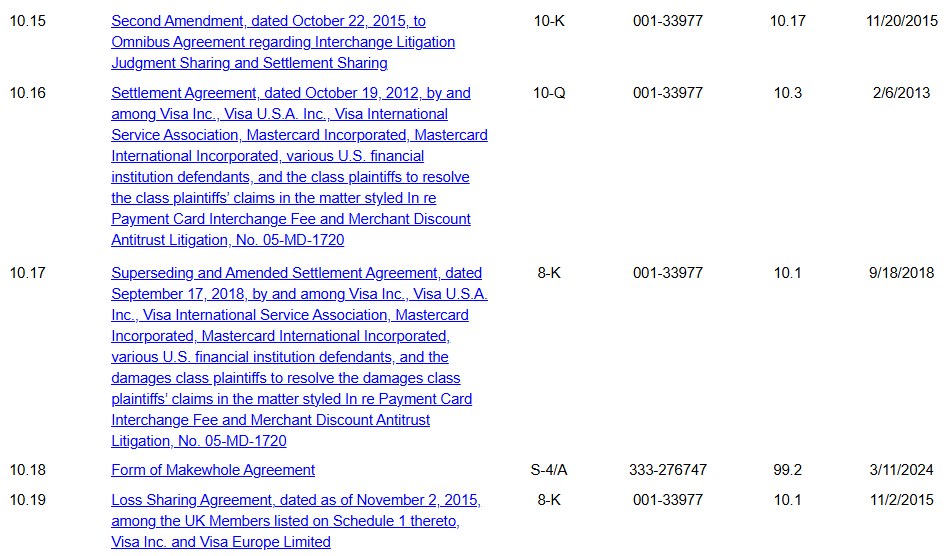
Visa’s 10-K links to dozens of Exhibits as external documents. Crawling only the main filing makes you with incomplete data, but tracking down every Exhibit requires significant resources. For most RAG engineers, processing all Exhibits simply isn’t feasible.
- Visa(V) 10-K
- https://www.sec.gov/ix?doc=/Archives/edgar/data/1403161/000140316124000058/v-20240930.htm
5. The Difficulties to Match Different Accounting Standards through XBRL Data
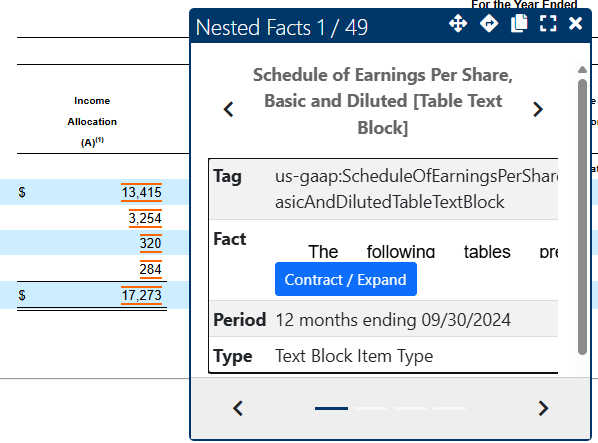
XBRL (eXtensible Business Reporting Language) is an XML-based standard that tags each number in financial statements with semantic meaning. It matters because comparing companies requires it.
Say you want to compare operating income between TSMC(TSM) and Broadcom(AVGO). Different accounting standards mean raw numbers aren’t directly comparable. That’s why you need XBRL tags to normalize the data. But XBRL is embedded as complex tags within tables, requiring substantial preprocessing and domain expertise to use effectively.
SEC data is inherently unstructured. Before LLMs came along, systematically leveraging this data was nearly impossible. LLMs have opened new possibilities, but RAG performance still depends heavily on data quality.
Reducing hallucinations and improving answer quality requires good RAG techniques, sure. But ultimately, the data you feed your system determines the results you get.